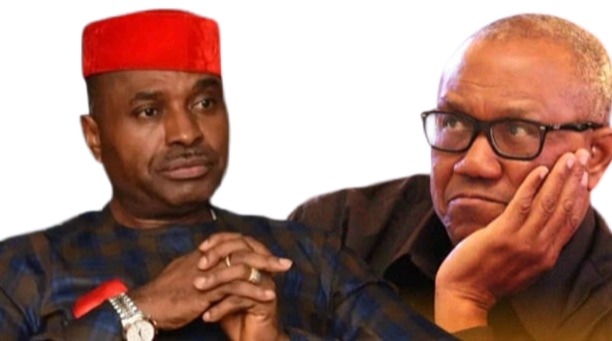
Why Kenneth Okonkwo’s War Against Peter Obi Is A War Against His Own Credibility — SERG Explains

This post has already been read 2480 times!
Group Says Former Obi Spokesman Faces Credibility Test Over Contradictory Positions, Backs N5bn Defamation Suit
The South East Revival Group (SERG) has offered what it describes as a fundamental explanation for why the sustained attacks by actor-turned-politician Kenneth Okonkwo against former Labour Party presidential candidate, Peter Obi, have become a credibility problem not for Obi but for Okonkwo himself.
In a strongly-worded statement signed by its National Publicity Secretary, Rt. Hon. Nnaemeka Aleke, the group argued that every allegation currently being made against Obi inevitably raises questions about the credibility of the man making them, given his long history as one of Obi’s most visible political defenders.
According to SERG, Okonkwo’s current criticisms are difficult to reconcile with the glowing endorsements he repeatedly gave Obi during their years of political association.
The group noted that Okonkwo was not merely a supporter but one of the leading public voices who sold Obi’s candidacy and leadership credentials to Nigerians.
“For years, he stood before Nigerians and passionately sold Peter Obi as the embodiment of integrity, prudence, competence, transparency, accountability and transformational leadership,” the statement said.
“He vouched for Obi’s character. He vouched for Obi’s judgment. He vouched for Obi’s capacity. He vouched for Obi’s integrity. He vouched for Obi’s fitness for the highest office in the land.”
SERG said it was therefore surprising that the same individual who once championed Obi as a model of good leadership now seeks to portray him in a negative light following the collapse of their political relationship.
The group maintained that this contradiction leaves Nigerians with an unavoidable dilemma.
“Which Kenneth Okonkwo should Nigerians believe?” the statement asked.
“The Kenneth Okonkwo who passionately told Nigerians that Peter Obi was one of the finest political leaders in contemporary Nigeria, or the Kenneth Okonkwo who now seeks to portray the same man in an entirely different light after their political relationship collapsed?”
According to SERG, both narratives cannot be correct simultaneously.
The organisation argued that if Okonkwo’s previous endorsements of Obi were genuine, then his current attacks lack credibility. Conversely, if his current claims are true, then Nigerians must question why he spent years promoting a leader he now seeks to discredit.
“If Kenneth Okonkwo was truthful then, why should Nigerians take his current attacks seriously? If he is truthful now, then why did he spend years misleading Nigerians?” the group queried.
“Either way, the greatest victim of this contradiction is Kenneth Okonkwo’s own credibility.”
SERG further contended that the issue extends beyond Peter Obi and touches on broader concerns about political consistency and integrity among public figures.
The group recalled that Okonkwo had previously directed strong criticisms at former Vice President Atiku Abubakar, vigorously opposing his presidential ambition and questioning his suitability for leadership, only to later find himself politically aligned with him.
“Yesterday’s enemy has become today’s ally. Yesterday’s hero has become today’s villain,” SERG noted.
“The question therefore is not about Peter Obi. The question is whether Kenneth Okonkwo stands for any enduring principle beyond the politics of convenience.”
The organisation also cited the example of Daniel Bwala, who moved from being a vocal critic of President Bola Ahmed Tinubu to serving in his administration, saying such political transformations have contributed to growing public cynicism toward Nigeria’s political class.
While acknowledging that citizens have the right to change their political opinions, SERG warned that frequent ideological reversals weaken public confidence in democratic leadership.
The group also reacted to the legal confrontation brewing between Obi and Okonkwo following reports that Obi had threatened a N5 billion defamation suit while Okonkwo promised to expose his former principal in court.
SERG said it welcomed the prospect of judicial scrutiny.
“The courtroom is not a television studio. The courtroom is not a political rally. The courtroom is not social media,” the statement declared.
“The courtroom is where evidence is tested, facts are scrutinised, and truth is separated from propaganda.”
The organisation challenged Okonkwo to present whatever evidence he claims to possess through lawful judicial channels.
“If Kenneth Okonkwo possesses credible evidence, he should present it before the court. If he does not, then Nigerians will know that the noise was merely noise.”
The group equally urged Obi not to be deterred by threats of sensational revelations and encouraged him to pursue any legal remedies available to protect his reputation.
“We therefore urge Peter Obi not to retreat, not to be distracted, and not to be intimidated by threats of sensational revelations. If there are grounds for legal action, he should proceed and allow the judicial process to run its course.”
In one of its strongest remarks, SERG called on Okonkwo to apologise both to Obi and Nigerians, arguing that his present position directly undermines the endorsements he repeatedly made in the past.
The group said Nigerians are now left with only two troubling possibilities.
“Either he misled Nigerians then or he is misleading them now. Neither possibility inspires confidence.”
SERG concluded by warning Nigerians against politicians and public commentators whose loyalties appear to shift according to political advantage rather than enduring principles.
The group described such individuals as “political weathercocks” who change direction whenever political circumstances change.
It urged citizens to evaluate leaders based on their records, values and measurable performance rather than on the changing opinions of political actors.
According to SERG, consistency remains one of the most important indicators of political credibility.
“History will always be kinder to those who remain consistent in their convictions than to those who repeatedly reinvent themselves to suit the politics of the moment,” the statement concluded.