This post has already been read 244 times!
The organisers of the 2026 Nigeria International Agricultural Expo (NIAEXPO) have reaffirmed their commitment to accelerating Nigeria’s agricultural transformation by bringing together key stakeholders, investors, policymakers, technology providers and industry experts to explore opportunities for economic growth.
The Project Lead of CEMS Tradeshow, Mr Yekeen Kazeem, said the eighth edition of the expo was strategically designed to strengthen collaboration across the agricultural value chain and promote transformational economic growth through innovation, investment, climate resilience and global trade.
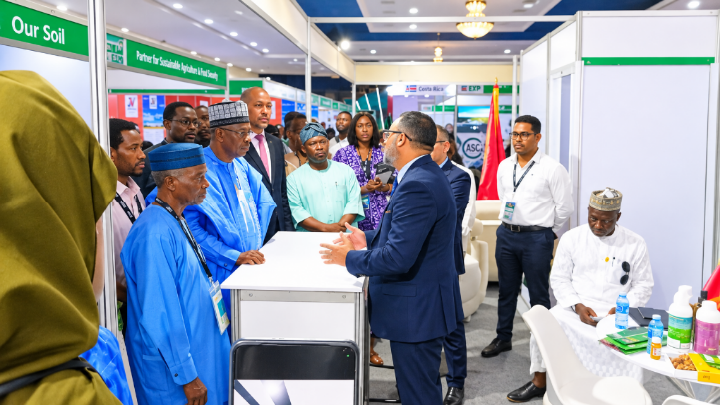
Kazeem stated this during his welcome address at the three-day exhibition, which commenced on November 17 and will run until November 19 at the Abuja Trade and Convention Centre, Abuja.
The expo, organised by CEMS Tradeshow, is holding under the theme, “Transforming Agriculture Through Innovation, Climate Change Resilience, Investment and Global Trade.”
According to Kazeem, the event provides a strategic platform for agricultural stakeholders to identify investment opportunities, exchange knowledge, showcase innovations and develop practical solutions capable of strengthening Nigeria’s agricultural sector.
“This event brings together agricultural stakeholders, investors, policymakers, technology providers and industry experts to explore opportunities for strengthening Nigeria’s agricultural sector through innovation, investment, climate resilience and international trade,” he said.
He explained that the programme features trade and exhibitor presentations, industry discussions, agricultural research and rural development sessions, alongside other activities designed to promote knowledge exchange and practical solutions for development in the sector.
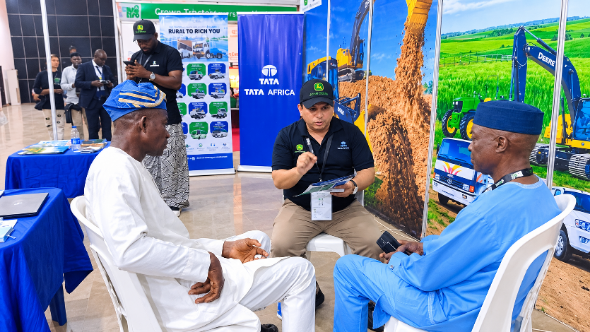
One of the exhibitors at the expo, the Country Director of Tata Africa Services and John Deere Tractors, Mr Bharat Nikam, highlighted the contributions of agricultural mechanisation to Nigeria’s economic growth, stressing that the company’s activities extend beyond the supply and sale of agricultural machinery.
Nikam said the company’s more than 20 years of operations in Nigeria had focused on developing a sustainable agricultural mechanisation ecosystem capable of improving productivity, creating opportunities and strengthening the agricultural value chain.
According to him, Tata Africa’s interventions have supported the cultivation of more than 10 million hectares of farmland across Nigeria, while mechanisation initiatives in areas where its equipment has been deployed have contributed to estimated yield improvements of between 30 and 40 per cent.
He explained that the company’s operations are anchored on three major pillars: sales, service and spare parts, supported by a network of dealers, business partners and Mechanised Service Providers (MSPs) across the country.
“Our belief is that mechanisation is not just about deploying machines. It is about building the nation,” Nikam said.
He added that the company had invested in training farmers, equipment operators, technicians, young people and women, noting that the effective utilisation of agricultural machinery was central to achieving improved productivity.
“We have invested in training farmers, operators, technicians, young people and women, because the real value of mechanisation lies in how effectively people can use the equipment to improve agricultural productivity,” he stated.
Nikam further emphasised that access to modern agricultural machinery remained critical to transforming Nigeria’s agricultural sector, increasing food production, expanding farm operations and reducing the operational difficulties associated with traditional farming methods.
He explained that properly deployed and maintained tractors enable farmers to cultivate larger areas of land within shorter periods, improve operational efficiency and maximise agricultural output.
Also speaking at the expo, the African Food Changemakers (AFC), a pan-African organisation focused on accelerating the growth of African-owned businesses, presented its interventions aimed at strengthening African food and agricultural enterprises.
The organisation was represented by its Membership Officer, Mr Nosa Obano, who outlined AFC’s ambition to develop one million successful entrepreneurs with global recognition and respect.
Obano said the organisation was intensifying efforts to address information gaps that prevent African agricultural businesses from accessing international markets and competing effectively in the global economy.
He explained that AFC supports entrepreneurs across the continent through capacity building, business networking, access to opportunities and the provision of relevant information and insights to improve business decisions.
According to him, the organisation’s mission is driven by the conviction that African food entrepreneurs and producers possess enormous potential but often lack the visibility, knowledge and business positioning required to compete successfully in the global marketplace.
He argued that the perception of Africa in some international markets as a continent characterised by poverty and hunger failed to reflect its actual agricultural potential, considering the productive capacity of the continent and the contributions of its farmers and entrepreneurs.
Obano identified inadequate business visibility and limited access to relevant market information as major challenges confronting African food businesses.
He noted that while many entrepreneurs had the capacity to produce quality agricultural products, they often lacked the knowledge and strategic support required to expand beyond their immediate markets.
Among the interventions highlighted by Obano were export development programmes designed to prepare African businesses for the requirements of international markets.
He also identified the Leading African Women in Food Fellowship programme as an initiative aimed at equipping women entrepreneurs with leadership capabilities, networking opportunities and the confidence to assume prominent positions in the food industry.
Addressing concerns about the ability of Nigerian agricultural products to meet international export standards, Obano argued that the challenge was not necessarily the quality of locally produced goods but, in many cases, the entrepreneurs’ inadequate understanding of export requirements.
He identified gaps in product branding, certification, market-specific regulations and other essential export procedures as major obstacles preventing many Nigerian businesses from successfully accessing foreign markets.
According to him, producing agricultural goods alone does not automatically qualify businesses for international trade, as exporters must understand the requirements of their target markets, including product presentation, branding and compliance with relevant certification standards.
“The sad reality is that it is not necessarily that they don’t meet export standards; it is that they lack information. Even down to product branding, the way you brand your product means a lot in the export space,” Obano stated.
The discussions and presentations at the 2026 NIAEXPO underscore the importance of collaboration among agricultural stakeholders, investment in modern technologies, capacity development and access to international markets in unlocking the potential of Nigeria’s agricultural sector.
Through its engagement of industry players, investors, policymakers, technology providers and business development organisations, the expo seeks to advance conversations and practical initiatives that can contribute to agricultural productivity, enterprise growth and the broader transformation of the Nigerian economy.