
This post has already been read 238 times!
Costa Rica-based Agricultural Services and Development (ASD Costa Rica), an international oil palm genetics and seed development company, is seeking to strengthen its engagement with Nigeria’s agricultural sector, showcasing its advanced seed technology, extensive genetic resources and nearly 100 years of research experience at the 8th edition of the Nigeria International Agricultural Expo (NIAEXPO) 2026 in Abuja.
The company, which participated in the three-day international agricultural exhibition held from November 17 to 19, 2026, at the Abuja Trade & Convention Centre, demonstrated how improved oil palm genetics, climate-adaptive varieties and sustained technical support can help farmers achieve better production outcomes and strengthen the commercial potential of oil palm cultivation.
The 2026 NIAEXPO, organised by CEMS Tradeshow, was held under the theme, “Transforming Agriculture Through Innovation, Climate Change Resilience, Investment & Global Trade.”
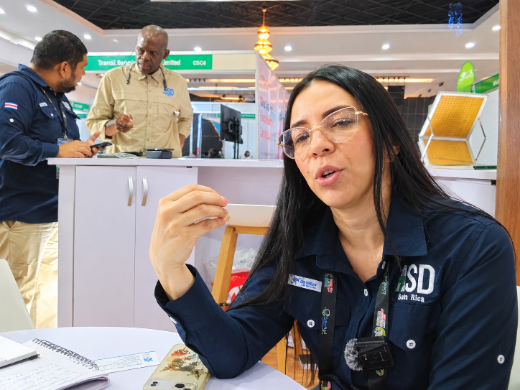
Speaking in an interview during the exhibition, Grethel, leader of the ASD Costa Rica delegation to NIAEXPO 2026, who also serves as a Unit Manager of the company, explained that ASD’s business model combines scientific research, genetic improvement, seed production and farmer support to deliver planting materials suited to different agricultural environments.
She said the company has invested decades in researching oil palm genetics, collecting genetic materials from different tropical regions and developing improved varieties through controlled cross-pollination.
According to her, the company’s research programme is driven by the need to address farmers’ changing production requirements, particularly the growing challenges associated with climate change, prolonged dry seasons, excessive rainfall and crop diseases.
“Our training programme, the main focus is to solve the necessities of the clients in the market. So, in our lab, what we do is we search for the genes that make the palms resistant to different conditions,” she explained.
Grethel disclosed that ASD collects oil palm genetic materials from different countries, cultivates them in Costa Rica and selects parent palms with desirable characteristics for cross-pollination.
The objective, she explained, is to combine beneficial genetic qualities to develop varieties that can deliver improved productivity under specific environmental conditions.
She noted that the company currently offers 10 different oil palm varieties in the market, with different characteristics designed to meet the production objectives of farmers.
While some varieties are developed to deliver higher oil content, others are suitable for farmers interested in producing more fresh fruit bunches. The company also has varieties with different levels of tolerance to dry and rainy conditions.
She explained that the selection of planting materials should depend on the farmer’s location, environmental conditions and intended market.
For instance, farmers whose primary objective is oil production would require varieties with higher oil content, while those targeting the sale of fruit bunches would benefit from varieties with greater bunch production capacity.
The ASD representative further emphasised that environmental conditions must be considered when selecting planting materials, as a variety that performs exceptionally well in one geographical location may not necessarily produce similar results elsewhere.
She disclosed that the company does not simply sell seeds and leave farmers to manage the production process independently. Rather, it maintains continuous engagement with clients to understand their needs and provide technical assistance.
“We take control of everything, from the parent palms in the field, to the pollination, to the process of those seeds, to germinate and package those seeds. So, we are taking care of everything so we can have the best quality seeds,” she said.
She added that the company’s responsibility extends beyond seed production to building long-term relationships with farmers and helping them achieve better results.
“It’s not only selling the product, it’s companionship with the clients to produce,” she stated.
Grethel also disclosed that ASD operates an international breeding programme through which it shares technical knowledge with agricultural stakeholders and collaborates with research institutions in different countries to conduct field trials.
She explained that the company engages farmers to understand their local weather and environmental conditions before recommending suitable varieties.
According to her, this approach is particularly important because transporting soil samples from one country to another can be difficult, and the soil’s structure may change during transportation.
Through direct engagement with farmers and partnerships with research institutions, ASD seeks to assess the suitability of its varieties under different production environments before making recommendations.
OIL PALM PRODUCTION: WHAT FARMERS SHOULD EXPECT
On the commercial prospects and production timeline of oil palm cultivation, Grethel disclosed that the trees could begin producing their first fruit bunches approximately 18 months after planting.
However, she explained that farmers would need to wait about five to six years for production to stabilise.
She also highlighted the importance of appropriate farm establishment and crop management, including good soil preparation, fertiliser application, irrigation and effective control of diseases and insects.
According to her, farmers can use either organic or chemical fertilisers, provided the application is properly managed.
She cautioned against excessive or inadequate irrigation, explaining that both conditions could adversely affect the survival and development of young plants.
She further stressed that successful oil palm cultivation requires consistent attention to the nutritional and environmental needs of the crop.
On seed quality and international trade, Grethel disclosed that the Costa Rican government regularly monitors ASD’s production and quality-control processes to ensure compliance with established standards.
She said government officials periodically inspect the company’s operations and certify its seeds to have 99.9 per cent genetic purity.
She also explained that additional phytosanitary treatments are applied where required by importing countries, citing Peru as an example of a market with strict sanitary requirements that necessitate specific pesticide treatments before seeds can be exported.
The certification and monitoring process, she said, provides an important quality assurance mechanism for the company’s international seed business.
FROM HISTORICAL AGRICULTURAL RESEARCH TO GLOBAL SEED BUSINESS
ASD Costa Rica’s position in the international oil palm seed industry is rooted in a long history of agricultural research and crop development in the humid American tropics.
The origins of the ASD brand are linked to the agricultural diversification efforts of Chiquita Brands International and its historical predecessor, the United Fruit Company, which conducted agricultural activities in the region for approximately a century.
The United Fruit Company introduced different crop species as part of its agricultural diversification programmes and established important germplasm collections, including a cocoa collection in Costa Rica and an oil palm collection at the Lancetilla Botanical Garden in Honduras, with the first oil palm introductions dating back to 1926.
Beginning in 1942, field experiments using genetic materials introduced from Southeast Asia and West Africa produced important results, confirming the superiority of the Dura Deli lines from Indonesia.
During the following decade, small oil palm plantations were established in Guatemala, Honduras, Nicaragua, Costa Rica, Panama, Colombia and Ecuador.
Approximately a decade later, a significant germplasm bank comprising Elaeis guineensis and Elaeis oleifera had been established, bringing together genetic materials from different tropical regions of the world.
The collection is currently recognised as the largest and most diverse private oil palm germplasm collection in the world.
Until 1960, research activities concentrated mainly on developing new seed varieties and improving oil extraction technology. Thereafter, research priorities expanded to include crop agronomy and phytosanitary protection.
Significant projects were subsequently undertaken in fertilisation, weed control, cover crop management, pollination, germination and seed physiology.
The growing demand for quality seeds exposed a major gap in the tropical American market, leading to the establishment of ASD de Costa Rica S.A. in 1986 as a specialised company focused on oil palm genetics and the production and sale of improved seed varieties and clones.
The company began exporting seeds to Africa in 1987 before expanding its international market to Southeast Asia.
On January 23, 2006, Compact Seeds and Clones S.A. was established as the company currently responsible for producing, processing and exporting seeds under the registered ASD Costa Rica trademark.
With its extensive genetic resources, research experience and international breeding programme, ASD Costa Rica has continued to develop improved oil palm varieties for different agricultural environments.
Its participation at NIAEXPO 2026 represents an opportunity to bring this experience closer to Nigerian agricultural stakeholders, particularly farmers, investors and businesses interested in the development of oil palm production.
The company’s approach underscores the importance of quality planting materials, scientific research, climate adaptation, regulatory certification and continuous technical support in building a productive and commercially sustainable oil palm industry.