
This post has already been read 266 times!
Tata Africa Services Nigeria Limited, in partnership with global agricultural machinery manufacturer John Deere, is making significant contributions to Nigeria’s economic development through agricultural mechanisation, human capital development, technology transfer and investments in commercial transportation, with more than 4,000 tractors deployed and over 10,000 Nigerian farmers, operators and technicians trained in the past two decades.
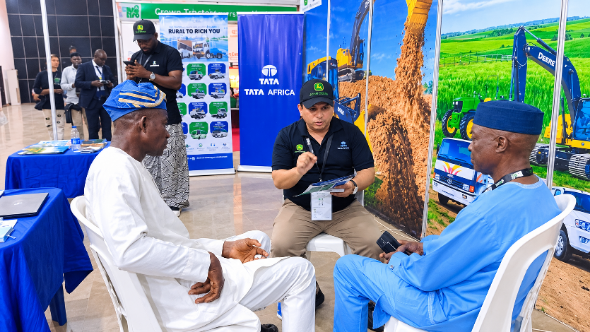
The Country Director of Tata Africa Services and John Deere Tractors, Mr Bharat Nikam, disclosed this during an interview at the 8th edition of the Nigeria International Agricultural Expo (NIAEXPO 2026), holding from November 17 to 19 at the Abuja Trade and Convention Centre, Abuja.
Nikam explained that the company’s contributions to Nigeria’s economy extend beyond the supply and sale of agricultural machinery, stressing that its more than 20 years of operations in the country have focused on building a sustainable agricultural mechanisation ecosystem capable of improving productivity, creating opportunities and strengthening the agricultural value chain.
According to him, Tata Africa’s interventions have supported the cultivation of more than 10 million hectares of farmland across Nigeria, while mechanisation initiatives in areas where its equipment has been deployed have contributed to estimated yield improvements of between 30 and 40 per cent.
He explained that the company’s operations are anchored on three major pillars: sales, service and spare parts, supported by a network of dealers, business partners and Mechanised Service Providers (MSPs) across the country.
“Our belief is that mechanisation is not just about deploying machines. It is about building the nation. We have invested in training farmers, operators, technicians, young people and women because the real value of mechanisation lies in how effectively people can use the equipment to improve agricultural productivity,” Nikam said.
Agricultural Mechanisation As A Driver Of Economic Growth
The Tata Africa Country Director noted that access to modern agricultural machinery remains critical to transforming Nigeria’s agricultural sector, improving food production, expanding farm operations and reducing the operational challenges associated with traditional farming methods.
He explained that properly deployed and maintained tractors enable farmers to cultivate larger areas of land within shorter periods, improve efficiency and maximise agricultural output.
Nikam identified Niger, Ekiti, Kaduna and Nasarawa states among the locations where the company has established significant agricultural mechanisation operations.
He added that digital monitoring and management systems are deployed to track equipment utilisation and performance, ensuring that agricultural machinery delivers maximum value to farmers and other beneficiaries.
The company also collaborates with the Federal Ministry of Agriculture, non-governmental organisations, agricultural associations and individual farmers to promote the adoption, effective utilisation and maintenance of modern agricultural equipment.
Over 10,000 Nigerians Benefit From Capacity Development
Beyond equipment deployment, Nikam highlighted human capital development as a major component of Tata Africa’s contribution to Nigeria’s economic growth.
He disclosed that more than 10,000 Nigerian farmers, tractor operators and technicians have benefited from the company’s training initiatives over the past two decades.
According to him, the training programmes are designed to equip beneficiaries with the practical knowledge and technical skills required to operate, maintain and maximise the benefits of modern agricultural machinery.
Explaining how interested farmers and individuals can access the opportunities, he said the company operates a structured training framework involving state governments, private institutions, agricultural associations and individual agricultural entrepreneurs.
He noted that annual training calendars are developed based on identified needs across states and geographical zones, with relevant ministries and agricultural mechanisation departments helping to identify and mobilise participants.
Mechanised Service Providers also serve as important partners in reaching farmers and equipment operators through their established customer networks.
Nikam disclosed that Tata Africa bears the expenses associated with its organised training programmes to ensure that participating farmers are not financially burdened.
He added that the company’s technical team provides on-site training whenever tractors are delivered to customers, ensuring that owners and operators understand equipment operation, routine maintenance, servicing requirements and warranty provisions.
To sustain the benefits of the training, the company maintains regular communication with customers through its technical and sales coordination teams, which conduct follow-up calls every 15 days to obtain feedback on equipment performance and address operational challenges.
Pioneering Innovative Tractor Financing And Ownership Schemes
Highlighting another dimension of the company’s contribution to agricultural development, Nikam recalled that Tata Africa Services Nigeria Limited pioneered an innovative tractor mechanisation arrangement more than 20 years ago through a lease programme that initially deployed over 800 tractors.
The initiative was designed to address the financial barriers confronting farmers and agricultural operators who could not readily afford to purchase modern tractors.
Following the initial two-year programme, the company introduced a rent-to-own arrangement, allowing beneficiaries to gradually acquire ownership of the equipment.
He disclosed that the initiative also facilitated the establishment of approximately 15 agricultural associations, each equipped with more than 50 tractors, thereby strengthening collective ownership and expanding access to mechanised farming services.
According to him, additional equipment was subsequently deployed to other Mechanised Service Providers to expand the company’s operational network and strengthen partnerships with local agricultural entrepreneurs.
The initiative helped create a more accessible framework for farmers and agricultural operators to benefit from modern machinery without necessarily having the financial capacity to make outright purchases.
Nikam maintained that such arrangements demonstrate the importance of innovative financing models and public-private partnerships in addressing the mechanisation gap in Nigeria’s agricultural sector.
Beyond Agriculture: Tata Africa’s Contribution To Transportation And Logistics
The company’s economic contributions also extend to Nigeria’s commercial transportation and logistics sectors.
Nikam emphasised that Tata Africa has maintained a presence in Nigeria for more than two decades, contributing to the development of commercial transportation through the introduction and supply of buses, trucks and other commercial vehicles.
He recalled that the company introduced its buses into the Lagos market around 2000, adding that its commercial vehicles have continued to serve Nigerians over the years.
According to him, Tata Africa’s long-term business philosophy is built around supporting national development through technology, local capacity building, strategic partnerships and the provision of dependable products and services.
The company’s involvement in agriculture and transportation, he explained, reflects its broader commitment to supporting Nigeria’s development through solutions that address critical economic needs.
NIAEXPO 2026: Promoting Innovation, Investment And Agricultural Transformation
Tata Africa and John Deere’s participation in NIAEXPO 2026 further underscores the growing importance of strategic partnerships, technological innovation and private-sector investment in Nigeria’s agricultural transformation.
The three-day exhibition, organised by CEMS Tradeshow, is holding under the theme, “Transforming Agriculture Through Innovation, Climate Change Resilience, Investment and Global Trade.”
The event brings together agricultural stakeholders, investors, policymakers, technology providers and industry experts to explore opportunities for strengthening Nigeria’s agricultural sector through innovation, investment, climate resilience and international trade.
Its programme features trade and exhibitor presentations, industry discussions, agricultural research and rural development sessions, alongside other activities designed to promote knowledge exchange and practical solutions for agricultural development.
For Tata Africa Services and John Deere, the exhibition provides an opportunity to showcase the role of modern agricultural machinery, technical expertise and sustainable mechanisation in addressing some of the challenges confronting Nigerian farmers.
With more than 4,000 tractors deployed, over 10,000 farmers and technical personnel trained, and millions of hectares of farmland covered by its mechanisation interventions, the company’s activities illustrate how private-sector investments can contribute to agricultural productivity, employment opportunities, skills development and economic expansion.
As Nigeria continues to pursue food security, economic diversification and sustainable development, the contributions of companies such as Tata Africa and John Deere highlight the importance of combining technology, accessible agricultural equipment, capacity development and long-term investment in building a more productive agricultural economy.
ABUJA BUSINESS REPORTS NEWSPAPER & MAGAZINE
About the Author